

Top 10 Cooking Class Couple AI Prompts for Playful Dessert Making with Sweet Treats
This collection gathers ten separate AI image prompts that all center on couples in romantic, playful, or stylized situations. The shared idea is a couple photographed together in a full-body composition, with warm lighting and ultra-realistic textures. The set is built for creators who want to generate polished couple imagery without writing every detail from scratch.
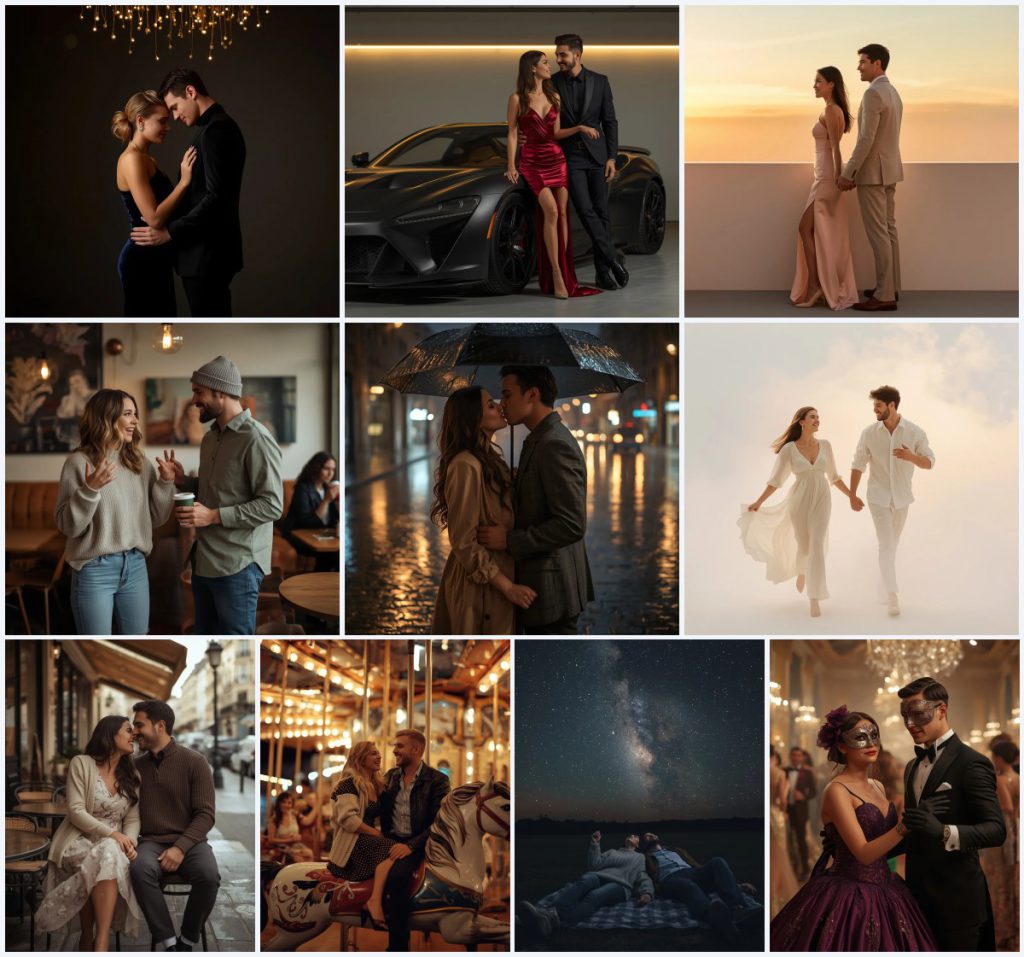
The prompts range from a dark studio with fairy lights to a rainy city street, a Parisian cafe, a carousel, a starry field, and a masquerade ball. Each prompt names clothing, pose, background, and lighting so the model has clear instructions. The article explains what appears in these prompts, why they work, which styles they support, and how to run them through common image tools.
What these couple prompts are asking for
Each prompt in this set describes a full-body couple image with specific wardrobe, pose, background, and lighting. The collection leans on realistic fabric textures, cinematic light, and emotional warmth rather than fantasy effects. Some prompts are studio-based, while others place the couple in a city, a cafe, a fairground, a field, or a palace.
- A full-body couple pose, often leaning, holding hands, laughing, or kissing.
- Named clothing such as a navy blue velvet gown, a black wool suit, a cherry-red satin cocktail dress, or a white chiffon dress.
- A defined background, including a dark minimal studio, a concrete garage, a Parisian cafe, a rainy street, or a baroque palace.
- A lighting description such as warm golden fairy lights, golden neon accents, golden-hour sun, or soft ambient cafe light.
- A lens and resolution note in several prompts, for example 50mm f/1.4, 85mm f/1.8, 24mm f/1.8, 8K, and HDR.
- An emotional tone such as romantic, playful, serene, mysterious, or whimsical.
The shared scene across the set
Every prompt is built around a couple in a single readable moment. One prompt says the pair is "leaning their foreheads together, eyes closed, with soft smiles" under "a delicate string of warm golden fairy lights." Another places them "leaning against a sleek, matte black luxury sports car" with "soft golden neon accent lighting." A third shows them "holding hands, looking out at the warm golden horizon" on a minimal luxury balcony at sunset.
The collection also moves into everyday and whimsical spaces. One prompt describes "a playful debate, gesturing animatedly" inside a coffee shop with artistic decor. Another shows a "passionate kiss under an umbrella on a rainy city street at night." Further prompts include running "hand-in-hand through a dreamy, mist-filled studio space," laughing at an outdoor Parisian cafe, sitting on a carousel, lying on a blanket under a starry sky, and posing at a masquerade ball in a baroque palace.
Why this couple prompt collection works
The set works because each prompt gives the model a complete visual recipe instead of a vague idea. Wardrobe, pose, background, and lighting are all named, which reduces random results. The repeated full-body framing also keeps the couple and their clothing visible, which matters when the outfit is part of the story.
- The prompts name real fabrics and colors, so the model can render velvet, satin, silk, linen, chiffon, and wool with more believable texture.
- The lighting is described in specific terms such as fairy lights, neon accents, golden hour, or ambient cafe light, which gives each image a distinct mood.
- The emotional direction, from playful debate to tender kiss, helps the generated faces carry a readable expression rather than a blank stare.
Three styles inside this collection
Three styles are available inside this collection, and each one stays within the wording of the prompts. You can choose the studio-romance look, the editorial lifestyle look, or the whimsical fairground look. All three keep the full-body couple framing and the realistic texture notes.
- Studio romance: This style uses the dark minimal studio, the white mist-filled space, and the warm string lights to create an intimate, controlled image with soft shadows and bokeh.
- Editorial lifestyle: This style leans on the luxury sports car, the concrete garage, the Parisian cafe, and the modern balcony to produce a high-wealth, viral editorial feel.
- Whimsical fairground: This style follows the carousel, the colorful fairground lights, and the starry field to build a nostalgic, cheerful, and slightly magical date scene.
How to run these prompts step by step
The process is the same for every prompt in the set. Start with one card, copy its text, and generate a first pass before adding your own reference. Then check the result against the prompt and refine only what is wrong.
- Copy the prompt. Open the card you want and copy the full prompt text exactly, including the lens, resolution, and lighting notes.
- Upload a reference. If you want a specific couple or outfit, upload a clear reference photo and describe which parts should carry over.
- Generate the first image. Run the prompt once without changes so you can see what the model does with the original wording.
- Check hands and face. Inspect fingers, hand contact, eyes, and smiles, because leaning and holding poses often break at the hands and face.
- Check the main object. Verify the car, umbrella, carousel horse, cafe table, or other named object is present and correctly shaped.
- Refine and rerun. Adjust one variable at a time, such as lighting or background, and rerun until the image matches the prompt's mood.
Choosing the right reference photo
A good reference photo makes these prompts much easier to control. The model needs to see the couple clearly, understand their proportions, and read the clothing shape before it can place them in a new scene.
- Use a sharp, well-lit photo where both people are fully visible from head to toe.
- Avoid heavy filters, extreme angles, or clothing that hides the body shape, because those confuse the pose and fabric rendering.
- Match the reference to the prompt's framing, so a full-body photo works better than a close-up selfie for these full-body scenes.
Which tools handle these prompts best
Different tools respond differently to long, detailed prompts. The table below compares four common options and notes what each one is useful for in this specific collection.
| Tool | Access | Typical realism | Useful here for |
|---|---|---|---|
| ChatGPT | Web and app | Good with guided edits | Rewriting the prompt into shorter clauses and checking that the velvet gown or satin dress is described clearly. |
| Google Gemini | Web and app | Good for scene logic | Testing how the rainy street, cafe, or carousel background reads before you commit to a final render. |
| Leonardo AI | Web with free tier | Strong texture rendering | Rendering the silk, linen, chiffon, and wool fabrics named in the prompts with visible surface detail. |
| Midjourney | Discord and web | High cinematic realism | Producing the golden-hour balcony, the starry field, or the masquerade ball with strong lighting and depth. |
Tips for better couple images
Small wording changes can improve these prompts a lot. The tips below focus on the real materials and objects named in the collection, so they stay useful for every card.
- Keep the fabric names intact, because velvet, satin, silk, linen, and chiffon give the model clear texture cues that generic words like 'nice dress' do not.
- Describe the light source in plain terms, such as string lights, neon accent lighting, or golden-hour sun, so the mood does not drift between generations.
- Name the key prop once, like the luxury sports car, the umbrella, the carousel horse, or the cafe table, and avoid adding extra props that compete with the couple.
Common problems and how to fix them
These prompts can fail in predictable ways, especially around hands, faces, and named objects. The table lists the most likely issues and the simplest change to make.
| Issue | What to change |
|---|---|
| Hands merge or fingers look wrong during leaning or holding poses | Simplify the hand contact, ask for hands clearly visible, and rerun the same prompt. |
| Faces look blank or the smile is stiff | Add a specific expression such as soft smiles, joyful laugh, or serene happy expression. |
| The named object, like the car or carousel horse, is missing or malformed | Move the object earlier in the prompt and describe its shape and color in one clear clause. |
| Lighting drifts away from the prompt's mood | Repeat the exact lighting phrase, such as warm golden fairy lights or soft ambient cafe lighting, and remove any conflicting light words. |
Frequently Asked Questions
Can I use these prompts for a single couple instead of a group?
Yes. Every prompt in this collection is written for one couple, so you can run any card as a single-couple image without changing the structure.
Do I need a reference photo to get good results?
No, but a clear full-body reference photo helps the model keep the couple's proportions and clothing shape consistent across generations.
Which prompt in the set is easiest to start with?
The coffee shop and Parisian cafe prompts are usually the easiest, because the lighting is soft and the pose is simple, with fewer props to render.
Conclusion
This collection gives you ten ready-made couple scenes, each with clear wardrobe, pose, background, and lighting notes. Start with one card, copy the prompt, generate a first pass, and check hands, face, and the main object before refining. The styles stay inside the prompt wording, so you can move between studio romance, editorial lifestyle, and whimsical fairground looks without rewriting the whole scene.
Only edit a photo you have the right to edit, and respect the people and places shown in your reference images.